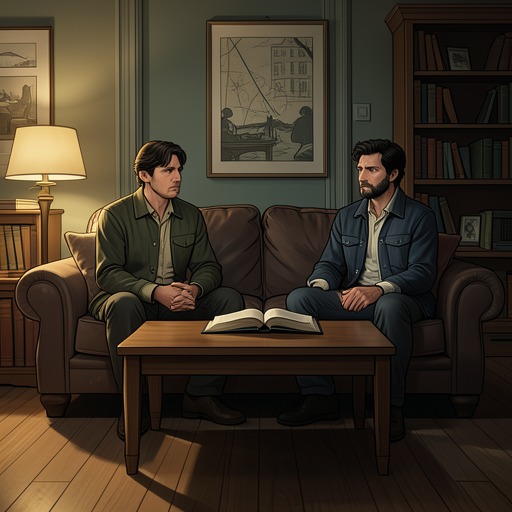
Eva and Magnus
Handling the UndeadEva and Magnus are mother and son, and their relationship is rendered through recognition, attempted closeness, and a crisis that Magnus cannot make sense of. Eva names Magnus as her boy when she sees him again; later, he lashes out during the encounter and privately blames his own thoughts for her anger. The scenes leave their bond present but strained, shaped by love and attachment on one side and a child’s fear and misunderstanding on the other.
Recognition and Reunion
Eva’s address to David and Magnus culminates in her identifying Magnus as her boy. The brief recognition establishes their relationship in personal rather than explanatory terms: she does not merely identify him as a child, but claims him as her own. In the scene’s compressed wording, that recognition is a concentrated sign of attachment, even as the surrounding circumstances make closeness difficult.
The reunion does not immediately become a settled exchange between mother and son. Magnus is close to Eva, who is in bed with cables attached to her head, but the scene also involves David and Balthazar. The family connection therefore appears within a larger moment of uncertainty rather than in an ordinary domestic setting. The evidence supports Eva’s recognition and Magnus’s presence beside her, but not a simple resolution of what has separated or troubled them.
A Birthday Gesture
David tells Magnus that it is his birthday and explains that, unable to make the pancake cake Magnus might have expected, he bought a cake instead. This small domestic detail places Magnus’s needs and familiar family rituals beside the exceptional circumstances of Eva’s condition. The cake is not presented as a cure for the tension, but it marks an effort to acknowledge Magnus as a child with a birthday to celebrate.
Magnus then makes a decision, overcoming what he feels, and steps up to Eva’s bed with Balthazar. The account connects this action to an effort of will: he acts despite an inward resistance. It does not explain precisely what he hopes to achieve by showing Balthazar, so the gesture should not be reduced to a definite promise or reconciliation. Its significance lies in the movement toward Eva. Against the birthday’s ordinary expectation of comfort, Magnus’s approach registers as a tentative act of contact in a situation that remains emotionally difficult.
A Crisis of Contact
The encounter shifts abruptly when Magnus screams and strikes Eva, his movements pulling loose the cables attached to her head. David intervenes, holding Magnus from behind and carrying him out of the apartment while trying to comfort him. The episode records an actual rupture in their attempted closeness: Magnus is physically beside his mother, yet distress overtakes whatever decision had brought him toward her. The scene does not establish that he intended to harm Eva or that his earlier gesture was insincere; it shows how quickly the meeting becomes more than he can manage.
The episode is also marked by confusion about whose distress is being perceived. David hears a scream in his head before hearing it with his ears, then realizes that the scream inside his head came from Balthazar. The distinction unsettles the boundary between an external sound and an experience inside the mind, while the scene places this uncertainty alongside Magnus’s visible distress. It does not show that Eva and Magnus communicate telepathically with each other. Rather, their encounter occurs in a wider environment where perception itself is difficult to trust, adding to the strain around the family’s attempt at contact.
Aftermath and Self-Blame
Later, Magnus wraps his arms around David’s hips and tells him that he had thought bad things about Mummy and believed that this was why she became angry. His explanation reveals how he has interpreted the earlier crisis: he connects his private thoughts to Eva’s anger and treats that connection as a reason for what happened. The account presents this as Magnus’s belief, not as an explanation confirmed by the narrative. Nothing in the evidence establishes that his thoughts caused Eva’s response.
That confession complicates the reunion’s emotional meaning. Magnus’s anger and distress do not cancel his attachment to Eva; his later worry shows that he remains deeply concerned with her and with how she responds to him. At the same time, his account suggests that he cannot clearly separate his own thoughts from events outside his control. He speaks to David, not directly to Eva, so the available scene does not show whether mother and son repair the rupture or what Eva makes of his distress. Their relationship remains defined by the contrast between Eva’s recognition of her boy and Magnus’s painful uncertainty about whether he has made her angry.